
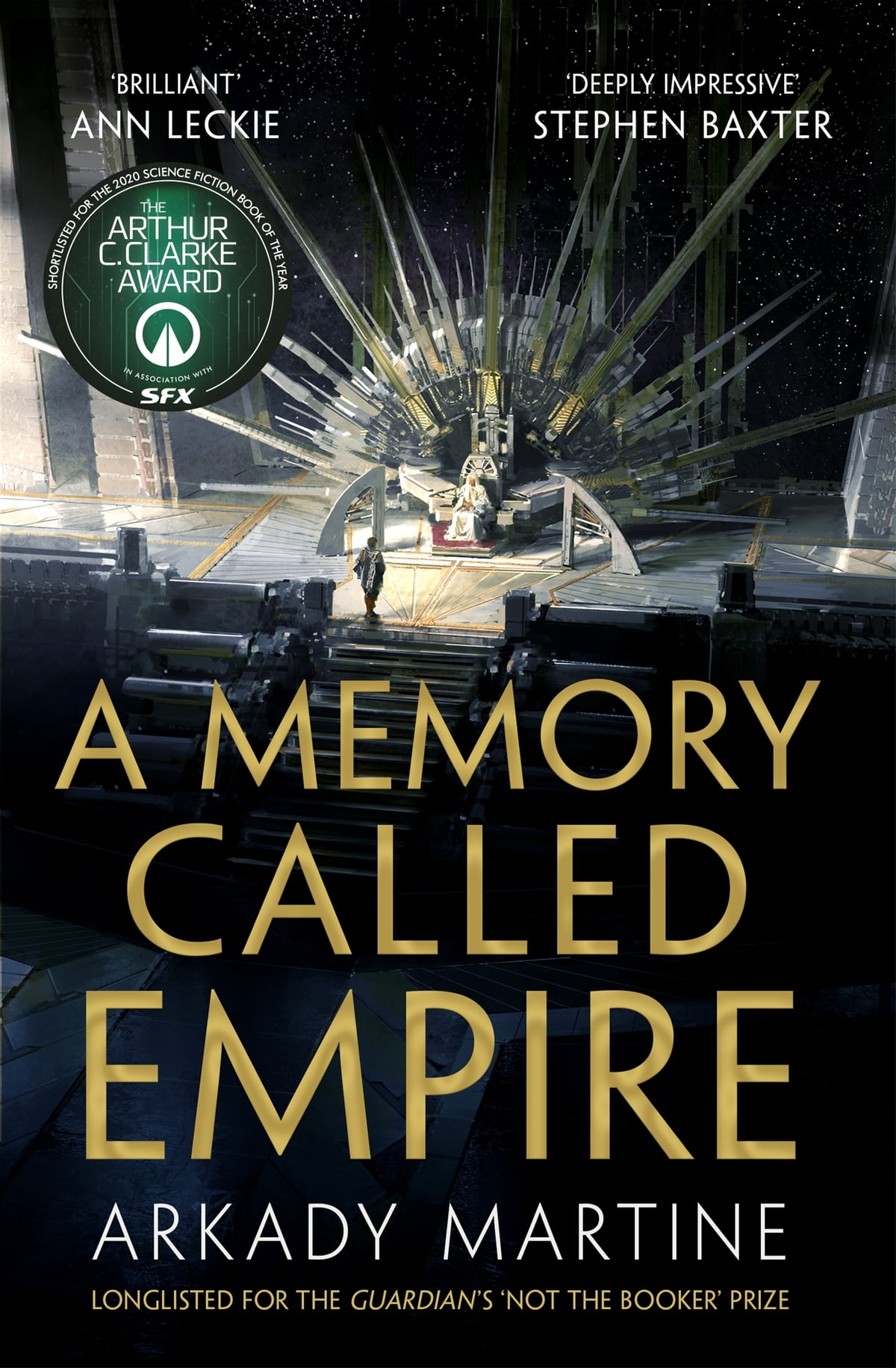
A Memory Called Empire by Arkady Martine
Published: 2019
Genre: Science fiction / space opera
My rating: 3/5 stars
I had pretty high expectations when I first picked up Arkady Martine’s debut novel. It won the 2020 Hugo Award and was a nominee for the 2019 Nebula Awards and 2020 Arthur C. Clarke Awards as well. On top of that, reviews were generally positive. Plus, the book seemed to hit all the right marks for me: Murder mystery, political intrigues, cool and original speculative elements. Check, check, check.
With that kind of build-up of expectations, it is no wonder I ended up feeling slightly disappoited.
Don’t get me wrong. It was in no way a terrible book, and I do get why so many people seem to love it. To me, though, it fell short in a couple of key areas. To help clarify whether this novel is something for you, I’ve set up the review as a pro-con list. If the cons don’t scare you away and political intrigues and space opera are your things, then A Memory Called Empire might just be the book for you.
Before we get to that, though, a short recap of the plot.
The story follows Mahit Dzmare, the ambassador from a small, independent mining station to the multi-system empire Teixcalaani. It starts while she is travelling towards the mega city that is the heart of the Teixcalaani empire as an replacement for her predecessor who has mysteriously disappeared.
Mahit’s primary mission is to keep the empire from swallowing her home station. To aid her, she has a neural implant which contains her predecessor’s memories and personality, but it is decades old and no updated version exists.
The plot evolves as she tries to figure out what happened to the previous ambassador, make the proper connections that will allow her to save her home from becoming part of the empire, and fights the loneliness that comes from living so far away from her home in strange world different from what she grew up in.
Pros:
- The prose: The story is very well written without ever falling trap to the pages long setting descriptions and naval-gazing that could have killed the plot completely. Poetry is a major element in the plot, so I guess I would’ve been thoroughly disappointed if the sentence level writing hadn’t been great.
- The neural implants: A good science fiction story needs a strong science fiction element, and A Memory Called Empire definitely delivers in that regard. The neural implants are a major part of the story, and the author managed to put her unique spin on an otherwise well-used SF trope. Also, the author cleverly used the neural implants to reveal part of the mystery later in the book.
- Inclusive without being all about inclusion: I really don’t want to open up a hornets’ nest of politics. I just want to say that I like that science fiction and fantasy books have become a lot more inclusive in later years, both when it comes to the authors and the subjects their stories center upon. However, I’ve also reached a point lately where I like to read good stories that aren’t only about how society treats minority groups (I like to read those stories too, but I want diversity in my stories).
A Memory Called Empire strikes a perfect balance here. Polygami and same-sex relationships are a big part of the story, but they’re not what the story is about. It never felt like the author preached their political views on the subject. Rather, these elements were simply there, a part of the backdrop for the story. - The murder mystery: Mild spoilers in this section:
It becomes clear pretty early in the stoy that Mahit’s predecessor was murdered (though, for some reason, the story keeps treating it as if it wasn’t necessarily murder for along while). That murder looms over the story like all encompassing shadow. It creates the main hook that kept me reading through to the end, as I wanted to figure out who did it, why, and what implications it will have for Mahit. - Stand alone: The book might be the first in the Teixcalaan series, but it read very much like stand alone novel (which is a big plus in my book; I’m really tired half the books in stores being part of a series that have already stretched far beyond what the original premise warranted). There is an overarching plot thread that’s left unfinished by the end of the book, but it takes up so little space in book one that I haven’t even mentioned it in this review.
Cons:
- The main character: This was probably where I was thrown out of the story the hardest, but also a point that might be very much a matter of taste.
Mahit was, to say it lightly, incompetent. Part of that is her being new in the job and being nervous, but it got to a point where she says to herself (paraphrasing, of cours): “I can’t trust these people. One of them literally works for a ministry that ‘used to be’ the spies of the empire. But hey, I’m lonely, so I’ll trust them just because.” She might well be the worst diplomat in the universe. And she really just stumbles through the plot, relying on luck as her incompetence gets her in trouble.
On top of that, she felt rather flat. I mean, she did have a personality and wasn’t just some cardboard figure, but it wasn’t enough to ever get me truly invested in her story. Honestly, a couple of the side characters were more interesting than Mahit. - The mysteries: This might read a bit strangely since I also put the murder mystery in the pros list, but as much as I liked the setup of the murder mystery and the political intrigues, the execution didn’t fully work for me.
The murder mystery especially could’ve been pulled off in a better way. The story keeps focusing on how certain characters denying that the death was a result of murder, which takes up a lot of space but isn’t really relevant at all. Worst of all, though, Mahit solves the mystery by asking one suspects (again, paraphrasing): “Hey, did you do it?” To which they sigh and answer (without being under any form of pressure) “Yeah, and here’s why, and here’s my culprit.”
I lost a good chunk of hair when I reached that part of the story. That just did not work as a resolution to the main plot hook.
The court intrigues also didn’t really work as well as I felt they should have. Partly, I guess it was due to Mahit’s incompetence, but mostly, it was probably because the intrigues revolved around subjects that weren’t really relevant for Mahit. The result was that Mahit stumbled through some political intrigues without really getting involved and without really giving me a reason to care. It’s too bad, though. There seemed to be a lot of potentiel there for a stronger story. - The empire theme: The big thematic element of the story, which really do take up a lot of pages especially towards the end, is empire; how empires affect other nations and their people culturally even before they expand and eat up those nations; how empires are made to expand, then implode; and most of all the allure of empire.
It’s that final part that didn’t quite work for me. The author does show how the emperial culture spreads and changes that of other nations, and she does show how unstable a multi-cultural empire is by its very nature (very on point with the current political situation in the US and why China’s government acts the way it does). But they never really showed why empires are particularly frightning or alluring.
Mahit’s thoughts regarding the empire and its cultural significance isn’t specific to empires, it’s more in the vein of someone moving from the countryside (or a small, remote mining station) to New York (or continent spanning mega city). Hey, it’s exactly the same way I felt when I move to the city to study.
So while Mahit’s situation is relatable, it feels like the book tries to force a theme that isn’t really there. This also ties into my final complaint… - The stakes: For a story that is all about war and murder and intrigues, it felt very low stakes. I think the problem was that it never really showed just why it was so important that Mahit kept her station from being annexed. Sure, they would loose their sovereignty, but it was never made clear if this would really change the way of life on the station all that much or in a negative way at all.
Likewise, while her predecessor was murdered and Mahit does come close to dying later in the story, for a long while it didn’t feel as if she was in any real danger.
What I ended up with was a book that felt like it a lot of potential, a book that was in many ways well-crafted, but also a book that staggered and fell when it came to some of the more basic elements of its plot.
Am I sorry that I read A Memory Called Empire? No, definitely not. Would I recommend it to other readers? That really depends on how willing they are to ignore what I see as its flaws? Will I read book two in the series? No, probably not. There are just too many books out there which are more likely to fit my taste.

 Toby Backman
One thought on “Book Review: A Memory Called Empire”